
Legacies of Nazi Persecution book wins Wolfson prize
Mary Fulbrook wins Wolfson History Prize
I pricked up my ears when I heard a familiar voice on Radio 4’s Today programme the other day. It was Professor Mary Fulbrook who was my much admired supervisor at UCL when I was researching my PhD on the Cold War. She has just won the 2019 Wolfson History Prize for her book Reckonings: Legacies of Nazi Persecution and the Quest for Justice. In her book she argues that thousands of Nazi war criminals, people who were complicit in mass murder, evaded justice during the years after the Second World War.

Reckonings: Legacies of Nazi Persecution and the Quest for Justice by Mary Fulbrook, winner of the Wolfson History Prize 2019
The book contains new research which shows up to a million people were involved in the extermination of Jews in Hitler’s death camps, yet only 6,600 were convicted. They ‘got away with it’ because they were not front-line killers. They were not guards in concentration camps. They were enablers, perhaps civilian administrators or maybe employers of slave labour – people who nevertheless became tangled up with the perpetrators of the Holocaust. These people were not tried for their crimes in the years after the war and went on to have good jobs and pensions. They were, says Mary Fulbrook, silently reintegrated into society.
Personal story
As she makes clear, there is a personal side to her research. Her mother was German, a refugee in the 1930s. Quite recently she discovered that the husband of her mother’s best friend had been a senior administrator in the area near Auschwitz. He was a part of the machinery, not an actual killer, but one of those who were involved or co-operated.
Mary Fulbrook argues that her historical analysis is important for two main reasons. Firstly it raises the question of how ordinary people can become complicit in a system which creates the conditions in which mass murder can take place. Secondly it asks how we can prevent future systems being created in which collective violence can happen and in which it is so easy to become complicit without feeling guilty.
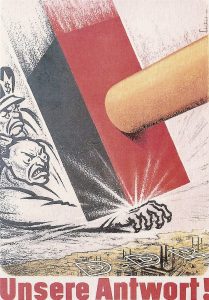
East German propaganda poster from the 1950s depicting West Germans as evil and grasping
An East German postscript
I have a postscript that I would like to add to Mary Fulbrook’s conclusions. Her book largely relates to what happened in the former West Germany after the war. My own experience both personally and as a historian relates to the former East Germany. Most early East German communist leaders had themselves been persecuted by the Nazis during the Third Reich. They were the ones who survived concentration camps or became refugees.
The message that they put out and which was largely discounted as communist propaganda at the time was precisely what Mary has argued in her book – that West German industry and administration was peopled by former war criminals.
Blinded by the Cold War
The Cold War made it impossible for anyone in the West to agree that the East Germans were right. But it follows from Mary Fulbrook’s research that they were.
So – the question is: were those on the other side of the Iron Curtain right about some other things as well. It is worth pondering on?
Comments
Legacies of Nazi Persecution book wins Wolfson prize — No Comments
HTML tags allowed in your comment: <a href="" title=""> <abbr title=""> <acronym title=""> <b> <blockquote cite=""> <cite> <code> <del datetime=""> <em> <i> <q cite=""> <s> <strike> <strong>